
Lee County Wanted List Status
The Lee County Sheriff's Office runs no most-wanted page. There is no count of fugitives, no posting schedule, and no photo feature on the official site. So anyone hunting for a countywide wanted roster comes up empty. The current-inmate list will not work as a substitute, because it tracks people already locked up. The Recent Arrests feed falls short too. It logs fresh admissions, some of whom bonded out right away, and it misses active warrants entirely.
Warrants are sealed off as well. Lee County has no public warrant portal. Per the county warrant magistrate, an unserved warrant is not a public record at all. If you suspect one exists in your name, the office wants you to show up in person at the sheriff's department. That policy leaves nothing honest to browse under a county banner, and it stops people from treating an unofficial name match as proof that a warrant is live.
Do not approach or try to detain anyone on a wanted page, and never rely on a third-party name match alone.
Opelika Wanted Listings
The county's one genuine photo list comes from the Opelika Police Department. It is a city operation. Opelika posts selected people its officers are seeking. Each entry includes an update marker and a tip line. Keep one thing in mind: the list says nothing about the Lee County Detention Center. A wanted notice comes first. A booking record only exists once someone is actually arrested.
The Opelika page is selective. It is not a warrant index. A name left off the list proves nothing about city, county, state, or federal warrants. So check the agency listed on each entry, read the charge as written, and use the contact info the page provides. If the person is later caught, the county's inmate and recent-arrest channels may show the booking.
Each Opelika listing carries a compact set of identifying and case details:
| Field | What it means |
|---|---|
| Name | The identity used in the municipal notice; compare carefully because names can repeat. |
| Image | An official city-posted identifying image. It may not be a current jail booking photo. |
| Alleged charge | The stated basis for the notice, not a finding of guilt or final disposition. |
| Update information | The city page’s own freshness marker, not a promise of instant status changes. |
| Tip route | The official channel for non-emergency information about the listed person. |
Some listings leave out physical descriptions or caution flags. Fill those gaps with nothing. Stick to what the official entry actually says.
The official Opelika wanted page stands as the city's own source, so images of listed people need not be copied anywhere else.
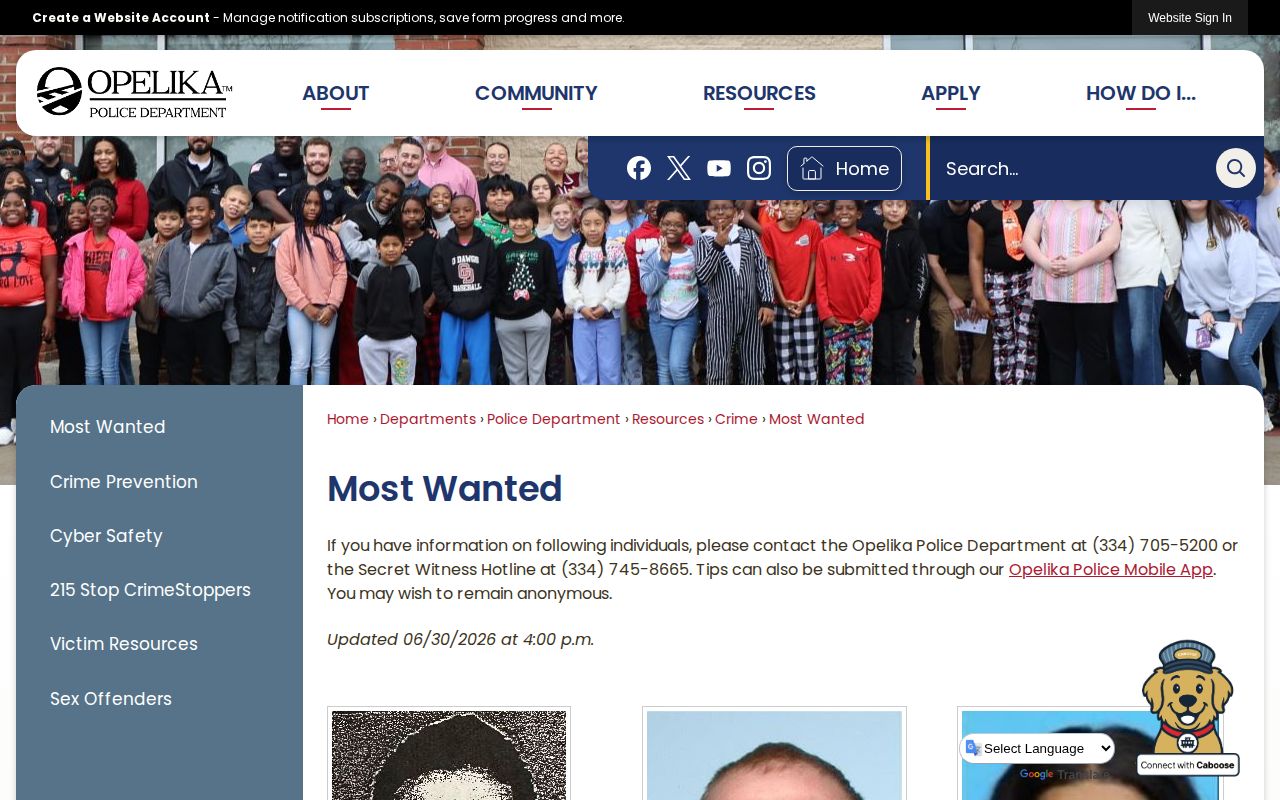
The city branding and the official tip route make the ownership plain: these listings belong to Opelika Police, not to a Lee County sheriff list.
Use Wanted Listings Safely
A wanted page exists to collect tips. It is not an invitation to make contact. Photos can be years old, look-alike names abound, and status shifts between updates. When you report something, keep the official listing open in front of you so the agency knows exactly which entry you mean.
- Open the official Opelika list and confirm that the city, name, image, and alleged charge match the notice you saw.
- Read the page’s update information. Do not assume an older screenshot proves a current warrant.
- Do not approach, follow, confront, warn, or try to hold the person. Move to a safe place.
- Call 911 for an immediate danger. Otherwise, use the Secret Witness Hotline or the responsible agency’s official tip channel.
- Give facts such as location, time, direction of travel, and the listing referenced. Let law enforcement assess the information.
Once an arrest happens, the Lee County booking and custody search helps separate a fresh admission from ongoing confinement. For outcomes like dismissals, pleas, or judgments, the court docket is the only true source.
Check a Lee County Warrant
Lee County keeps its warrant process tight on purpose. The magistrate's page says an unserved warrant stays out of public view and sends anyone concerned to the sheriff's department in person. Call the warrant magistrate at (334) 737-3526 with questions. The clerk directory adds two more lines: Administrative Assistance/E-Warrants at (334) 737-3505 and E-Warrants/Expungements at (334) 737-3501. These numbers route a question. They do not turn into a phone lookup service.
Jurisdiction picks the office for you. County magistrates take felonies, misdemeanors charged outside Auburn and Opelika, certain traffic matters, and worthless-check cases. Plenty of Auburn and Opelika misdemeanors belong to their municipal courts instead. A city case should stay in the city system, even if the person lives in Lee County.
Follow this check-and-resolve process:
- Identify the likely issuing court or agency from the incident location and type of charge.
- Read the official magistrate instructions and call the listed office if jurisdiction is unclear.
- For the county path, follow the direction to appear at the Lee County Sheriff’s Office. Do not depend on an unofficial database.
- A person concerned about their own legal exposure may consult a licensed attorney and coordinate with the court or sheriff.
- After resolution, use the court record to confirm the filed case and its final disposition.
Note: This sequence is for verification and resolution only, not for delaying or avoiding service of a warrant.
Lee County Warrant Jurisdiction
The route depends on the issuing court and the charge. Lee County magistrates handle the matters listed on their page. Auburn and Opelika municipal courts take many city misdemeanors. A wanted listing is just one agency's selective public notice. It never replaces the court's own record.
| Matter | Published jurisdiction | Where to verify |
|---|---|---|
| County felony | Lee County warrant magistrates | County magistrate, clerk, or responsible law-enforcement agency. |
| Misdemeanor outside Auburn or Opelika | Lee County warrant magistrates | County magistrate and the proper state court. |
| Relevant traffic or worthless-check matter | Lee County warrant magistrates | County magistrate or issuing court. |
| Auburn or Opelika misdemeanor | Generally the applicable municipal system | The relevant municipal court or police department. |
A jail roster row differs from everything above. It confirms who was in custody at a given moment, often after a warrant was served, but it says nothing about the full judicial history.
Lee County Tip Routes
Two main routes exist for passing along information. The LCSO tip form handles non-emergency leads, and you can attach a location or image if you have one. Contact fields are optional. Keep in mind that optional fields do not guarantee full anonymity, and the form is not a tool for checking warrants or reporting crimes in progress.
Opelika runs a Secret Witness Hotline tied directly to its wanted program. The sheriff's office keeps a separate countywide channel. Pick whichever agency published the notice or holds jurisdiction, and stick to what you personally witnessed rather than hearsay.
Opelika Secret Witness Hotline(334) 745-8665
Lee County Sheriff’s Office
W.S. “Buck” Jones Administration Building
1900 Frederick Road
Opelika, AL 36801
Main: (334) 749-5651
If danger is happening right now, call 911 instead. Do not drive to any listed address, and never try to confirm a tip by confronting someone yourself.
Lee County Warrant Court Records
A warrant being served and a booking do not close out the legal story. The case file may later hold a complaint, indictment, amended charge, motions, a dismissal, a plea, trial results, sentencing, or an appeal. Lee County state cases run through Alabama's Thirty-Seventh Judicial Circuit. Certain Auburn and Opelika misdemeanors stay in municipal court. Begin with a case number if you have one. Without one, match the full name, the filing date, the court division, and the jurisdiction that issued the charge.
A zero result from a remote search settles nothing. Indexing often lags behind a same-day booking. Names get spelled differently. Municipal courts hold some matters, and access can be restricted. The Lee County clerk offers in-office electronic viewing plus a written copy and search form as official fallbacks. Report only what the court record actually shows on a given date. A posted bond is not a final outcome, and a wanted page dropping a name tells you nothing about why it changed.
When an official listing looks stale, send the publishing agency a precise link. Where it matters, add a certified court record. Skip unofficial intermediaries who claim to interpret warrants. The agency that issued the notice and the court controlling the case are the proper channels for corrections.
Lee County Warrant Payment Scams
The Lee County Sheriff's Office warns that it never demands warrant, fine, or release money through an unexpected call, text, or email. It also does not accept payment by money-transfer app, gift card, or cryptocurrency. Hearing a real officer's name proves nothing about the caller. A local number on caller ID proves nothing either.
Hang up. Dial the sheriff or court directly using a number you look up yourself. Never use a callback number the caller gives you. A genuine warrant matter moves through the magistrate, the court, your attorney, and the sheriff. Urgent threats and demands for secret payment are red flags, not how a Lee County case gets resolved.