
Lee County Arrest News Sources
Official releases drive most Lee County arrest coverage. The Opelika Police News & Updates stream posts arrest notices, wanted bulletins, and calls for help identifying suspects. Auburn goes another way. Its Open Line archive collects selected city releases in one place. Neither source works as a daily blotter. A post shows up only because the agency chose to publicize that incident, not because every booking gets a mention.
The Lee County Sheriff's Office posts alerts and case updates on social media too. Its current-inmate and Recent Arrests pages do a different job. They answer who is in custody and who was just booked. News posts bring story and context. A reporter may name the arresting agency and the charge, while the county intake system supplies the NameID, admission date, bond amount, and booking photo if one exists.
A news story about a charge is just that, a story. Prosecutors can amend or drop it, and the court record holds the final answer.
Lee County Outlet Comparison
No single outlet shows the whole county. Agency posts and newsroom stories run on an event-driven schedule, the sheriff feed rolls out items as they come, and private sites refresh on their own claimed timetable. Treat none of these as a complete court history.
| Outlet | Coverage | Photos? | Source type |
|---|---|---|---|
| Opelika Police News | Selected Opelika arrests, wanted notices, and identification requests | Portraits, graphics, or stills may appear | Official agency |
| Auburn Open Line | Selected Auburn incidents and arrests | Varies by release | Official city |
| Auburn Plainsman | Campus and city reporting, including a police-contributor archive | Varies | Independent news |
| O-A Now | Auburn, Opelika, county police and court stories | Agency or scene images may appear | Independent news |
| WRBL / WTVM | Regional Columbus-market crime reports affecting Lee County | Booking, wanted, graphic, or scene images vary | Independent news |
| Busted Newspaper | Copied Lee County booking entries in reverse chronology | Usually | Unofficial aggregator |
| RecentlyBooked | Private county filters and a default thirty-day view | Usually | Unofficial aggregator |
| Arrests.org / Mugshots.zone | Empty or stale Lee nodes during research | Historical where populated | Unofficial aggregator |
Each type of source answers a different question. Official agency statements tell you who spoke first. Independent newsrooms bring interviews and court context. Private booking pages work only as secondary date leads, since they can lag, skip records, or leave an entry up after release.
Auburn Police Publication Trail
The Auburn Plainsman maintains a contributor archive credited to the Auburn Police Division. That source label creates an unusually clear route from police announcement to publication. Selected items can contain an arrest date, allegation, jail destination, and bond detail. Images may be a supplied portrait, scene image, or another press asset. The archive still is not an Auburn booking roster.
Auburn’s own Open Line archive is the official starting point. Its releases often state that an arrested person went to the Lee County Jail and include a presumption-of-innocence notice. For a reported Auburn arrest, compare the release with the county Recent Arrests feed or current roster. Then search the correct municipal or state court. The city/university enforcement mix makes the arresting body, booking custodian, and court three facts that should be checked separately.
The police-contributor archive is useful for tracing selected reports. Its event-driven entries cannot support a claim that no other Auburn arrests occurred.
Opelika Police News Patterns
Opelika Police publishes the strongest official city-specific stream in Lee County. Posts may announce an arrest, ask the public to identify a suspect, or circulate a wanted notice. Those categories are not interchangeable. A surveillance still in an identification request is not a mugshot. A wanted image does not mean the person has been booked.
Because Opelika is the county seat, addresses and agency names can cause confusion. The Opelika Police Department creates city incident and arrest reports. The Lee County Sheriff’s Office runs the detention center and its booking system. A person arrested by OPD can therefore appear in LCSO data after intake. The city news post and county booking entry document different stages.
The official stream has no stated promise to publish every routine booking or update at fixed hours. Check the post date, agency, allegation, and any custody statement. Then return to the county feed for current facts.
How Photos Reach Lee News
How does a photo end up in Lee County news? Sometimes the agency publishes one itself. Other times a reporter files a public-record request with the right custodian, where Alabama law allows. The general baseline for citizens sits in Alabama Code § 36-12-40, though other laws and exemptions still apply. No enacted Alabama law requires mugshot publication. None bans removal fees either. A bill sitting in the legislature is not law, and shouldn't be described as one.
Reporters often get a booking image by asking the custodian directly. LCSO holds the detention-center intake photo. Auburn or Opelika may hold case media or the arrest report. Some records can legally stay withheld. That covers juvenile, youthful-offender, expunged, unexecuted-warrant, and open-investigation material. A missing press image might reflect policy, confidentiality, or plain editorial choice.
Once an agency hands over a picture, the newsroom may crop it or pair it with other visuals. That doesn't make the newsroom the custodian. Pulling an image from an official feed later never erases an independent story.
Note: Request the exact record and event date, since a city case photo and a county intake photo can sit with different custodians and carry different fees.
From Lee Story to Record
Start with the story, then check the record. A news report or a copied booking image is only a first look at someone's status. Follow the trail in order. That habit keeps a stale headline from turning into the final word on where a person stands today.
- Identify the publishing source, arresting agency, event date, and exact charge stated in the story.
- Check LCSO Current Inmates for present Lee County Detention Center custody, or Recent Arrests for a recent admission that may include a released person.
- If the web entry is gone, request the booking record and intake photograph from LCSO with the name, NameID if known, date, and agency.
- Search the proper Lee County, Auburn, or Opelika court using the case number when available. Compare filing dates and parties.
- Read the case-action summary for amendment, dismissal, plea, judgment, or another dated disposition. Do not treat jail bond or disposition fields as the judicial outcome.
Want the full picture? The Lee County booking and roster path separates two things people often confuse. One is current confinement. The other is a rolling feed of recent admissions. Someone released from jail can still show up in the recent feed even after the live roster drops their name, so the two lists rarely match perfectly.
Lee County Court Follow-Through
Lee County sits in Alabama's Thirty-Seventh Judicial Circuit. For remote searching, the state courts offer Just One Look by name or case number. Expect fees. The service charges $9.99 for a search with one case detail, then $9.99 for each added case. Images cost $5 for the first twenty pages and $0.50 per page after that. Cheaper options exist. District and circuit records can be viewed electronically at the clerk's office at no charge during business hours, under the court privacy rules that took effect in 2025.
Court level matters too. Auburn or Opelika misdemeanors may land in municipal court. Felonies move through the state system. A search that returns nothing can mean many things: a misspelled name, a timing gap, the wrong court, a confidential case, or slow indexing. Treat a zero result as a prompt to look harder, not as a clean answer.
- Booking
- Detention-center intake after an arrest.
- Bond
- Terms governing release while a case is pending, not a case outcome.
- Disposition
- The court’s recorded result or action in a case.
- Nolle prosequi
- A prosecutor’s formal decision not to continue a charge at that point.
Follow every case with exact court language and dates. Dismissed and acquitted are not the same outcome.
Unofficial Lee Mugshot Archives
Turn to private county pages last, after the official sources. Busted Newspaper keeps a deep, reverse-chronological Lee archive. RecentlyBooked adds filters for name, charge, date, and gender, along with its own last-updated note and a thirty-day default view. Both can reach further back than the LCSO feed, which runs about a week.
The other two private nodes tell opposite stories. Arrests.org has a real Lee section but showed no results at the snapshot. Mugshots.zone held older records yet stopped at a February 2025 cutoff. A blank private page never proves arrests stopped. A deep archive never proves anyone is still in custody. No current Mugshots.com Lee landing page checks out, so it is left out as a local source.
Treat these pages as leads, not answers. Republished charges and photos can be copied, trimmed, or dated wrong. Verify every name through LCSO and the proper court. Never identify a person from a republished face alone.
The RecentlyBooked Lee interface shows how far private filters can stretch past the official week-long window.
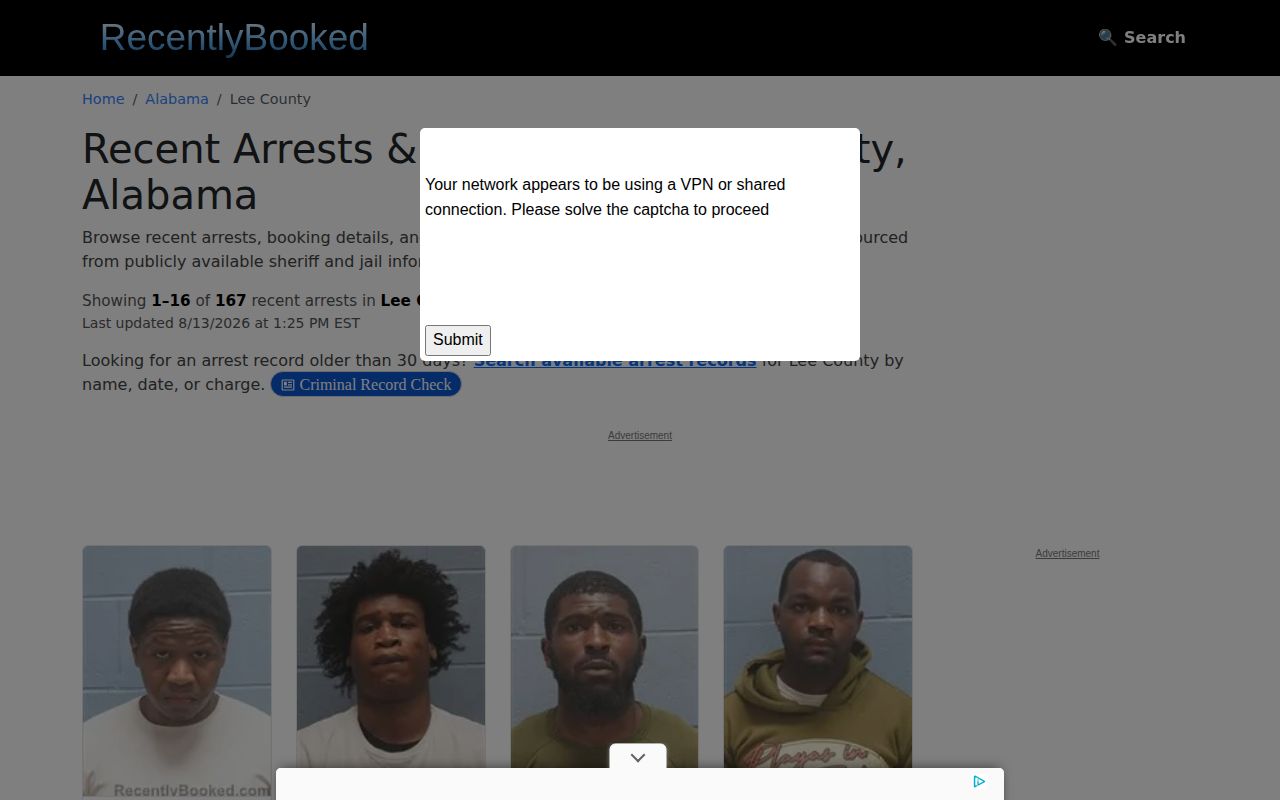
A longer private view is good for one thing: a date lead. For who is actually in custody, and how a case ended, go back to LCSO and the court.
Lee News Records and Archives
A page vanishing from the web does not mean the government record vanished with it. LCSO publishes no fixed retention term for booking photos. The live roster tracks confinement. Recent Arrests holds arrests for seven calendar days at a time. Anything older may still sit with the agency, waiting on a narrow in-person request.
For retention questions, the Alabama Department of Archives and History publishes records-disposition schedules. An RDA sets how long an agency keeps a record and when it may lawfully dispose of it. It is not a photo archive. No transfer of Lee County booking photographs to the state archives has been verified, so ask LCSO which schedule series covers the record you want and whether the agency still holds it.
News archives work by their own rules. Editorial and technical choices shape what survives there. A good account pairs the first report with the later, dated court result rather than swapping one for the other, since a charge can change after the story breaks.
Note: News pages, the jail feed, and the court docket each update on their own schedules, so temporary mismatches among them are normal.